
Fat Liberation Month: Reclaiming Language, Honoring History, and Fighting for Size Justice
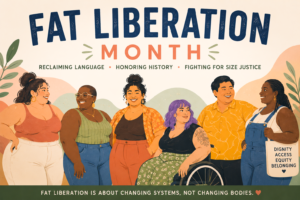
August is Fat Liberation Month! A time to celebrate fat people, recognize the history of fat activism, and examine the systems and beliefs that contribute to anti-fat bias and discrimination.
At its heart, fat liberation asks us to imagine a world where people are not judged, excluded, or denied opportunities because of the size of their bodies. It asks us to move beyond the idea that people must change their bodies in order to deserve dignity, respect, healthcare, belonging, or full participation in society.
For a practice committed to weight-inclusive and Health at Every Size® principles, Fat Liberation Month is an opportunity to reflect on how the language we use, the assumptions we make, and the systems we participate in can either reinforce or challenge weight stigma.
Why Do We Use the Word “Fat” within Fat Liberation?
For many people, the word fat can carry a lot of emotion. It has historically been used as an insult, a criticism, or a way of assigning negative characteristics to someone’s body. It makes sense that many people have learned to experience the word as something shameful.
Fat liberation challenges that assumption.
Within the fat liberation movement, fat is increasingly used as a neutral descriptor—much like tall, short, brunette, or left-handed. It describes a characteristic of a body without automatically assigning that body a value judgment.
For those who do use the word fat, however, reclaiming it can be powerful. It separates the word from the belief that being fat is inherently bad, unhealthy, lazy, unattractive, or less worthy. This distinction matters because fat is a body descriptor, not a character trait.
Reclaiming language does not erase the harm that has been associated with the word. Rather, it gives us an opportunity to question why a neutral description of a body became a source of shame in the first place.
A Brief History of Fat Liberation
Fat liberation did not begin with today’s social media conversations about body positivity. It has roots in decades of organizing, advocacy, and resistance by fat people and their allies.
In 1969, Bill Fabrey founded what was then called the National Association to Aid Fat Americans after witnessing the discrimination experienced by his wife, Joyce. The organization would eventually become the National Association to Advance Fat Acceptance (NAAFA), one of the longest-running organizations advocating for the rights of fat people.
Around the same time, feminist activists in California were organizing around the treatment of fat people and pushing for something more radical than simply “acceptance.” These activists formed the Fat Underground, a group that became one of the cornerstones of the fat liberation movement of the 1970s.
The Fat Underground distinguished fat acceptance from fat liberation. Their focus was not simply on encouraging individuals to feel better about their bodies—it was on challenging the social structures that created discrimination against fat people in the first place.
In 1973, the Fat Underground released the Fat Liberation Manifesto, which called for equal rights for fat people in all areas of life and directly challenged the industries and cultural systems built around “reducing” fat bodies. Other fat feminist groups, including collectives in New Haven and Boston, also contributed to this growing movement and advocated for fat women’s inclusion within feminist spaces.
The movement continued to grow throughout the 1970s, 1980s, and 1990s. Fat activists challenged discriminatory practices, protested fatphobic advertising, appeared in the media, organized demonstrations, and created communities where fat people could experience belonging and visibility.
Over time, these efforts helped lay the groundwork for movements that many of us recognize today, including body positivity, body acceptance, body neutrality, and Health at Every Size®. But it is important to remember that these contemporary conversations did not emerge in isolation. They are connected to decades of work by fat activists—many of them women and feminists—who challenged the idea that fat bodies needed to be changed before they could be respected.
What Does the Law Say About Weight Discrimination?
One of the most striking examples of the work that remains to be done is found in our legal protections.
In the United States, weight is not currently listed as a protected class under federal anti-discrimination law. That means there is no federal law that broadly prohibits discrimination simply because of someone’s body size or weight.
Michigan stands out as the only state with an explicit statewide law prohibiting discrimination based on weight. Michigan’s Elliott-Larsen Civil Rights Act, passed in 1976, includes height and weight among protected categories in employment and other areas covered by the law.
A small but growing number of cities and local jurisdictions have also enacted protections. These include municipalities such as San Francisco, Santa Cruz, Urbana, Binghamton, New York City, and Madison, as well as Washington, D.C., where “personal appearance” is included among protected categories.
And while Washington State does not have a law specifically naming weight as a protected class, state law has recognized “obesity” as potentially qualifying as a disability under its anti-discrimination protections. This is an important distinction because it means the protection is connected to disability law rather than providing universal protection based solely on body size.
The legal landscape is slowly changing, but these protections remain the exception rather than the rule.
Fat Liberation Is About More Than How You View Your Body
It can be tempting to think of body liberation as simply learning to love what we see in the mirror.
But what happens when the problem isn’t how someone feels about their body?
What happens when the problem is that the world treats their body differently?
Fat people can experience discrimination in employment, healthcare, education, housing, public spaces, and everyday social interactions. Weight stigma can also have significant consequences for mental (and physical) health and can contribute to experiences such as depression, eating disorder symptoms, and harmful weight-control behaviors.
This is why fat liberation is ultimately about justice, access, and equity—not just body image.
A person should not have to learn to love their body before they deserve to be treated with dignity.
We say this knowing that over 99% of all weight loss programs, when evaluated over a five-year period, fail utterly, and also knowing the extreme proven harmfulness of frequent large changes in weight. (1973)
Where do we go from here?
Fat liberation invites all of us to consider the ways we may unintentionally participate in weight stigma—and how we can do things differently. Most importantly, we can begin to separate body size from moral value. The work of the Fat Underground and generations of fat activists before us reminds us that this movement has always been about more than appearance. It is about freedom, dignity, access, and the right to live fully in the body we have.
If you want to learn more, here are some great resources to explore:
- NAAFA: National Association to Advance Fat Acceptance
- ASDAH: Association for Size Diversity and Health
- Center for Body Trust
- Ragen Chastain’s Weight and Healthcare Newsletter
Here are some of our favorite local resources:
- Bigger Bodies Boston
- The Thicket in Worcester: Consignment Shop for Fat Folx
- More to Love Yoga
- Ample Access Outdoors
- All She Wrote Books
- Fat Joy Jubilee
- Body Liberation Outdoor Club
Books/Literature:
- What We Don’t Talk About When We Talk About Fat (Aubrey Gordon)
- Fat and Queer: An Anthology of Queer and Trans Bodies and Lives
- You Just Need to Lose Weight: and 19 other myths about fat people
- Belly of the Beast: The Politics of Anti–Fatness as Anti-Blackness
- Fearing the Black Body
- The Body is Not An Apology
- Fat Talk
- You Have the Right to Remain Fat
Podcasts:
- The Fat Doctor
- Burnt Toast
- Maintenance Phase
- Body Trust
Websites:
Instagram Accounts:
@virgietovar — Virgie Tovar
@ragenchastain — Ragen Chastain
@heysharonmaxwell — Sharon Maxwell
@yrfatfriend — Aubrey Gordon
@bodyimagewithbri — Bri Campos
@theshirarose — Shira Rosenbluth
@centerforbodytrust – The Center for Body Trust
This is not an exhaustive list by any means but a good place to start!
This month, we honor the history—and continue the work. In fact, you can too!
Click here to sign the petition for SIZE FREEDOM!